Denver Conditions · part 3 of 3 · Ice Maker Repair
Cloudy, Hollow or Fused Ice: What Denver Water Does to a Sub-Zero Ice Maker
Written by Curtis Mahoney Refrigeration technician — defrost and control faults · 16 years in the trade
Reads the defrost cycle before he reads the compressor: heater, terminator, then drain, in that order. A blocked drain and a dead heater present as the same sheet of ice, and only one of them is worth a part.
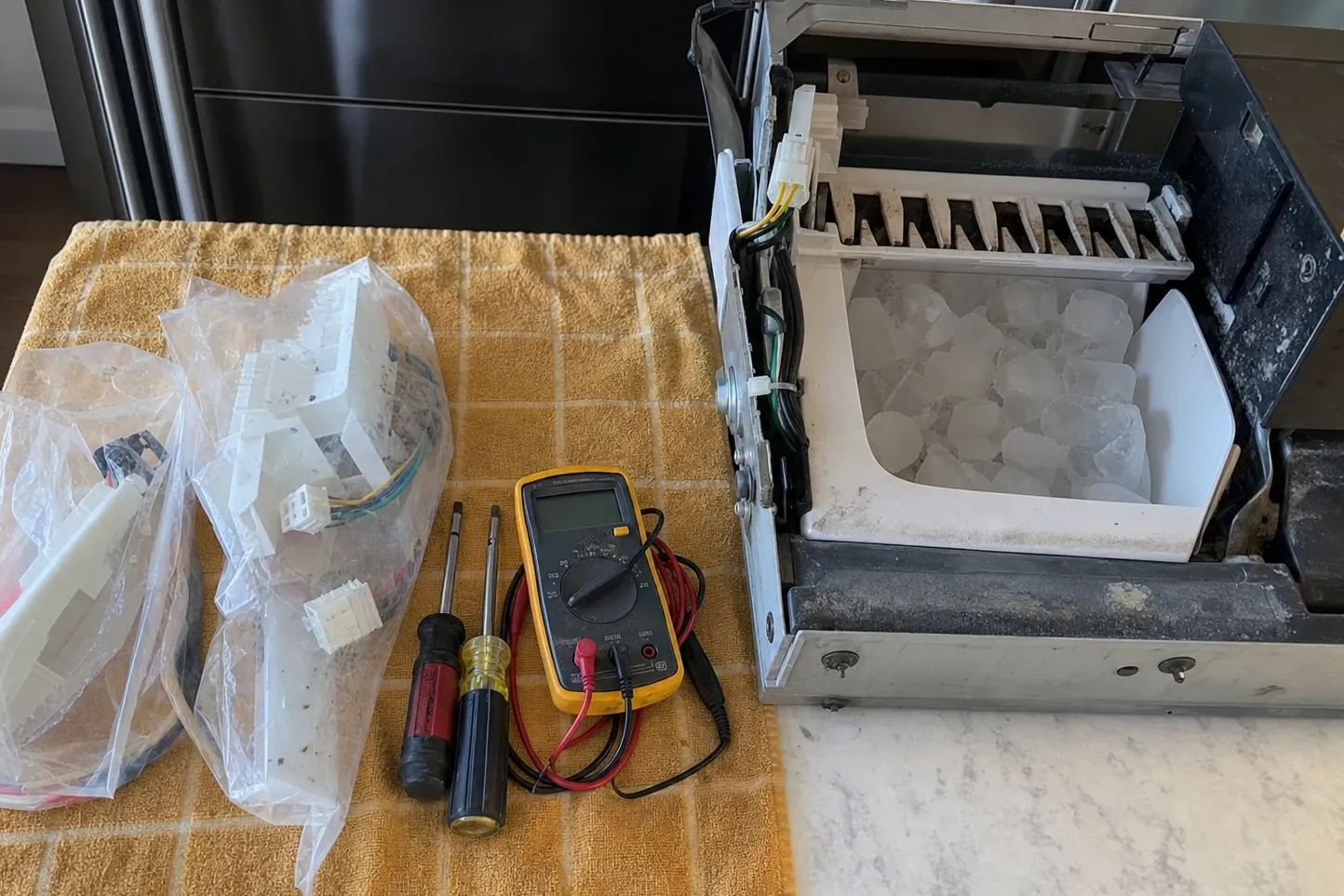
Ice is the most legible part of a Sub-Zero. Refrigeration hides its faults behind a panel, but an ice maker hands you a physical sample of its own condition every few hours. Learning to read the cube gets you most of the way to the fault before anyone opens the machine.
Read the cube before you read the machine
Four shapes come up again and again, and they mean different things.
Hollow cubes, thin walls. Not enough water reached the mould, or the freeze was cut short. On a mould-and-ejector ice maker that is a fill problem: a restricted inlet valve, a filter that has been in place too long, or line pressure that has dropped. On a clear-ice module it can also be the water distribution over the plate.
Cloudy or white cubes. Ice turns cloudy when it freezes fast enough to trap air and dissolved minerals instead of pushing them ahead of the freezing front. Clear-ice modules are built specifically to avoid that: they freeze slowly, layer by layer, and let the concentrated water run off. When a clear-ice unit starts producing cloudy ice, something in that slow-freeze process has changed — flow over the plate, cycle timing, or scale insulating the plate itself.
Small cubes that shrink over weeks. This is nearly always fill: the same volume of water is not arriving each cycle. Scale on the fill cup and a partly plugged inlet screen are the usual suspects here, in that order.
A bin of cubes fused into a slab. The cubes are arriving wet, or they are melting and refreezing after they land. Slow harvest, a warm bin, or water sitting in the base.
Note what none of these mean: a compressor problem. An ice maker with a genuine sealed-system fault does not make bad ice, it makes no ice at all, and the freezer around it is usually in trouble too.
Scale is a fill problem, not a taste problem
Denver water is not the hardest in the country, but it carries enough calcium and magnesium to leave deposits anywhere water sits and evaporates. In an ice maker, water sits in exactly three places: the inlet screen, the fill cup or trough, and the mould or evaporator plate.
Scale on those surfaces does two things, and neither is about flavour.
It restricts the opening water passes through, so fill volume drops. That is the mechanism behind small and hollow cubes. And it insulates the metal that has to get cold, which lengthens the freeze and blunts the temperature difference the harvest depends on. A furred plate can add minutes to a cycle, and those minutes show up as fewer cubes a day rather than as an obvious failure.
A house that leaves an undercounter ice maker switched on but unused for a season scales faster than one making ice daily, because standing water evaporates and leaves everything it carried behind. If a unit has been idle over the winter, run it, then look at the fill cup before assuming the module is at fault.
Descaling is a genuine repair step here, not a cleaning upsell: on a scaled unit it restores fill volume and cycle time, and it is the difference between a part replacement that was needed and one that was not.
Why a harvest cycle stalls
Harvest is the moment the ice lets go of the metal. A mould-type maker warms the mould slightly and an ejector arm sweeps the cubes out. A clear-ice module warms the plate and the sheet releases, then it is cut or broken into cubes. Either way three things have to be true: the ice has to be fully frozen, the warming has to happen, and the mechanism has to be free to move.
The failures follow from that list.
- Ice not fully frozen — a short cycle, low fill, or a warm bin. The harvest tries, the ice tears, and you get slush and fused lumps.
- No warming — the harvest heater or hot-gas path has failed. Cubes stay in the mould, and the machine sits with a full mould and no output. This is the classic no-harvest presentation.
- Mechanism bound — the ejector arm or the plate mechanism is stiff with mineral deposits, or a cube has jammed in the chute. Sometimes audible as a cycle that starts, strains and stops.
- Bin sensor blinded — the unit thinks the bin is full because the sensor is reading through a film of mineral haze. Production simply stops with room in the bin, which is the least obvious version of this fault and the easiest to fix once it is identified.
The leak that refreezes under the drawer
The other regular Denver call is not about ice quality at all. Water escapes — from a cracked fill cup, a split supply line, a loose fitting or a drain that cannot clear — and it does not evaporate. It runs to the lowest point, freezes there, and grows into a ridge under the drawer or a plate of ice at the base of the cabinet. Owners find it when the drawer stops sliding.
Two things worth knowing. First, the drain matters as much as the supply: an ice maker melts a little constantly, and if that water cannot leave, it stays. Second, that ice is heavy, and prising it out with a screwdriver is how the fill cup and the drain fitting get broken. Warm water and patience, or a service visit.
What to check before you call
Five minutes, no tools.
Find the filter and work out its age. If nobody remembers changing it, that is the answer to the age question. Replace it and give the unit a full day.
Look for white deposits. Fill cup, mould or plate, and the screen at the inlet if you can see it. Visible scale means descaling belongs in the repair.
Check the shutoff valve is fully open. A half-closed valve under the sink or behind the unit produces exactly the symptoms of a failing inlet valve, and it also causes the water hammer people describe as a thump every twenty minutes.
Watch one full cycle if you have the patience. Where it stops tells you which of the four harvest faults you have — full mould, torn ice, straining mechanism, or no attempt at all.
Look under the bin. Any ice that is not a cube is a leak, and a leak found early is a fitting rather than a fill cup.
Bring the model and serial when you call. On ice makers more than anything else, the module, valve and filter differ between families, and having those numbers is what puts the right part on the van instead of on order.
Follow-ups
- Will a new filter fix cloudy ice on its own?
- Sometimes, and it is the cheapest thing to try first. A filter that has been in place for years restricts flow as well as passing minerals through, and low fill is one of the two causes of cloudy, hollow cubes. If new-filter ice is still cloudy after a full day of production, the problem is fill volume or the freezing cycle, not the water.
- How often does a Sub-Zero ice maker need descaling in Denver?
- There is no fixed interval; it depends on how much ice you make. The honest answer is: when you can see white deposits on the fill cup, the mould or the evaporator plate. On a unit in daily use here that tends to be every year or two, and one that sits idle for months scales faster because the water in it evaporates in place.
- The bin is full of cubes fused into one lump. Is the module finished?
- Usually not. Fused ice almost always means the cubes are being harvested wetter than they should be, or that the bin is warming and refreezing between cycles — a slow harvest, a warm bin from a door or seal fault, or a drain that is backing water up under the ice.
Descaling that does not hold is an ice maker repair job. On a 500 Series cabinet the module and its switch are of that era too. Which module you have is decided by the model on the plate .