Denver, CO · series reference and repair
Sub-Zero repair in Denver for older and current series — $89 service call, credited
What the $89 buys: the visit, and a full diagnosis — temperatures logged on both circuits, the defrost side and the controls tested, the sealed system read under gauges.
The visit and a full diagnosis are $89 flat. Approve the repair and that $89 comes straight off what you pay.

- $89 service call One flat figure for the visit, taken off the repair you approve
- Nine series documented 500, 600, 700, BI and Classic, Professional — plus plate, parts and refrigerant
- Read at 5,280 feet Gauge pressures judged against Denver ambient, not a sea-level chart
Prices
Six bands, and the one figure above them
A repair on a built-in lands in one of six bands. Which one is settled at the diagnosis, and the number inside it is agreed with you before anything is dismantled.
| Band | What moves the figure inside it | Range |
|---|---|---|
| Door seal or drawer gasket | How many seals, and whether the door has to come off its hinges to take the old one out. | $270–$680 |
| Fan motor, evaporator side or condenser side | Condenser side is behind the grille; evaporator side means the interior panel and duct come out first. | $320–$700 |
| Defrost circuit: heater, limit or thermistor | One sensor is quick. A heater buried behind a frosted evaporator is most of a morning. | $280–$610 |
| Ice module, inlet valve or fill line | Whether the module alone is at fault, or the valve and the line back to the shutoff go with it. | $260–$750 |
| Control board or user interface | Board alone, or board and the display it drives. Older boards are the ones that need sourcing. | $390–$1,000 |
| Sealed system: compressor, drier or charge | Recovery, the part, a new drier, evacuation and a measured recharge — the cabinet usually comes out. | $1,490–$3,180 |
| Replacing it instead | a new built-in of the same width, with no cabinetry or fitting counted in | $11,900–$23,680 |
The bottom row is there for scale, not as a recommendation: on a cabinet with a clean sealed system, four of the six bands above sit under a tenth of it. Work with no band — a part nobody catalogues any more — is quoted after the diagnosis and never before.
Two ways in, and nothing to fill in
Give us the model number and what the cabinet is holding. That is usually enough to know which circuit is at fault before anyone is dispatched — and which parts belong on the van.
Series
Five generations, and where yours sits
Read the designation off the rating plate and pick the row. Each one opens a page on that series: what is in it, what fails with age, and which parts are still supplied.
| Series | Models | What it comes in for |
|---|---|---|
| 500 Series | 501R · 501F · 511 · 532 · 542 · 550 · 561 · 590 | Condensers packed with lint behind the grille, tired ice modules, seals that have taken a set |
| 600 Series | 601R · 601F · 611 · 632 · 642 · 650 · 661 · 685 · 695 | One circuit warm while the other holds, defrost heaters and thermistors, control boards |
| BI and Classic built-ins | BI-30U · BI-36U · BI-36UFD · BI-42SD · BI-48SD | Condenser fan motors, doors dropping on a hinge, panel-ready fronts that stop pulling shut |
| 700 Series integrated | 700TR · 700TCI · 736TR · 736TCI · 700BR · IC-27R | Frost behind the interior panel, the ajar chime after thirty seconds, drawer slides and seals |
| Professional | PRO 48 · PRO4850 · 648PRO | Ice maker and container, the filtration behind the grille, condenser behind the same grille |
Not sure which row you are on? The plate is inside the door near the top hinge on a full-size cabinet, and inside the cabinet to the left of the upper drawer on an integrated one.
Older units have their own section: the series reference covers nine of them. Find the model first — where the plate is lists it family by family. Past twenty years, parts go in what order .
What we repair
Four machines, and the way each one tells you
Every call starts as a sentence like one of these. The symptom decides which circuit gets opened first.
-

Refrigerator Repair
Fresh-food circuits on built-in, integrated and undercounter cabinets, from the 500 Series onward.
- One side warm, the other side still hard
- Condenser fan or compressor running and never cycling off
- Standing water under the crisper drawers
-

Freezer Repair
Freezer columns and drawers that frost up, drift warm or stop clearing the evaporator.
- Sheet ice across the rear evaporator cover
- Drawer sticking or refusing to run out on its slides
- Cabinet sitting in the teens instead of near zero
-
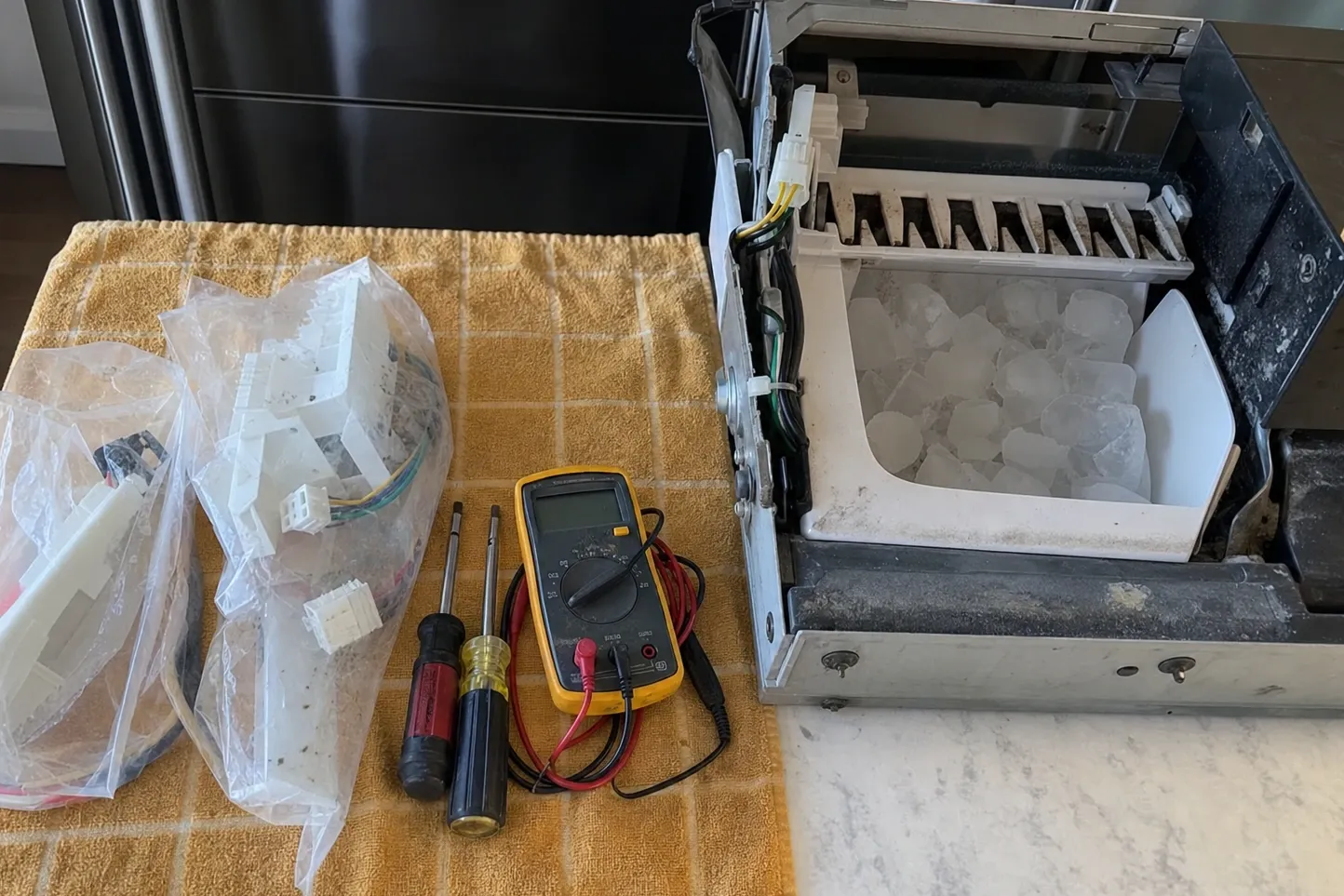
Ice Maker Repair
Harvest faults, scale and leaks on Sub-Zero clear-ice modules and the water path behind them.
- No harvest at all, or a mould that never empties
- Cloudy, hollow or fused cubes
- Scale from hard city water choking production
-

Wine Cooler Repair
Zone drift, glass-door condensation and fan noise on Sub-Zero wine cabinets and undercounter units.
- One zone several degrees off the number on the display
- Condensation forming on the inside of the glass
- Fan whine or vibration audible from the next room
The visit
Plate, diagnosis, figure — in that order
-
01
Read the plate, then call
Model and serial from the rating plate, plus the temperature each side is holding. That settles the series, the parts list and which spares belong on the van before anyone is dispatched.

-
02
Diagnosis you can watch
Temperatures logged, defrost and controls tested, the sealed system read under gauges against Denver ambient rather than a sea-level chart. The $89 covers that work and is credited to the repair.

-
03
A number first, then the work
The band and the figure inside it are agreed before anything comes apart. The cabinet is run back down to temperature on the visit and the readings are shown to you at the door.

Reviews
What owners say once the van has gone
Built-in calls in Golden Triangle, Five Points, Virginia Village and Belcaro.
5.0/ 51,250 reviews
Bottles in the lower zone sat warmer than the reds above, which is backwards. The divider fan had quit, so the zones were sharing air. New fan, both steady.
Vesna L.Golden Triangle
Our built-in sits in an alcove with almost no clearance and had crept up to the mid fifties overnight. He found the condenser fan motor dead. Replaced, vacuumed the coil, back to temperature by lunch.
Iliana V.Belcaro
Panel-ready wine column between two cabinets, and the fan noise had become a whine you could hear from the hall. Bearing on the evaporator fan. He pulled the unit, changed it and slid it back without a mark.
Godfrey T.Belcaro
Questions
Asked on the phone most days
How do I find out which Sub-Zero series I have?
Open the door and read the rating plate. On a 500, 600, BI or Classic cabinet it sits near the top door hinge on the inside of the door; on a 700 Series or integrated unit, left of the upper drawer inside the cabinet. The plate gives model, serial and manufacture date.
Is a thirty-year-old Sub-Zero still worth repairing?
That is a parts question, not an age question. Seals, fan motors, defrost heaters, thermistors and ice modules are ordinary stock items on these cabinets; a discontinued board or a failed compressor is where the arithmetic changes. Give us the model and the serial and the answer takes one call.
Does my series have electronic diagnostics?
It depends on the generation. The 500 Series manual documents temperature controls, a master power switch and automatic defrost, and no electronic control system at all. The 600 Series has an electronic control panel accurate to one degree, and the 700 Series adds a service indicator that lights when the control system finds a fault.
What does the visit cost?
Eighty-nine dollars, flat, for the trip and the whole diagnosis — and that $89 is deducted the moment you approve a repair. The repair comes out of six bands, settled before anything is dismantled. Work no band covers is priced after the diagnosis, never guessed at on the telephone.
The plate says R-12. Can it still be fixed?
Usually, yes. Everything outside the sealed circuit — seals, fans, defrost parts, controls, ice modules — is unaffected by which refrigerant is inside. It is work on the sealed circuit itself that turns on what the plate says, because production and import of CFCs in the United States ended on 1 January 1996.
Which Denver neighbourhoods do you cover?
Golden Triangle, Five Points, Virginia Village, Belcaro, Hale and Crestmoor. Those are the pockets where older built-ins are still sitting in the niches they were fitted into, which is what this practice is set up for. Vans run every day, 8 am to 8 pm, and somebody picks the phone up at any hour.
Neighbourhoods
Six pockets of Denver with older built-ins in them
Museum-district towers, Welton Street conversions, brick ranches off Colorado Boulevard and estate kitchens by the Phipps grounds — different cabinetry, the same five generations of machine.
-

80204
Golden Triangle
Museum-district towers and lofts: integrated columns, undercounter units, bar refrigeration.
-

80205
Five Points
Victorian row houses and Welton Street conversions, kitchens gutted in the 1990s and since.
-

80222
Virginia Village
Brick ranches of the 1950s, many still holding the built-in their niche was cut for.
-

80209
Belcaro
Estate kitchens off the Phipps grounds: paired columns, a wine cabinet, sometimes a third unit.
-
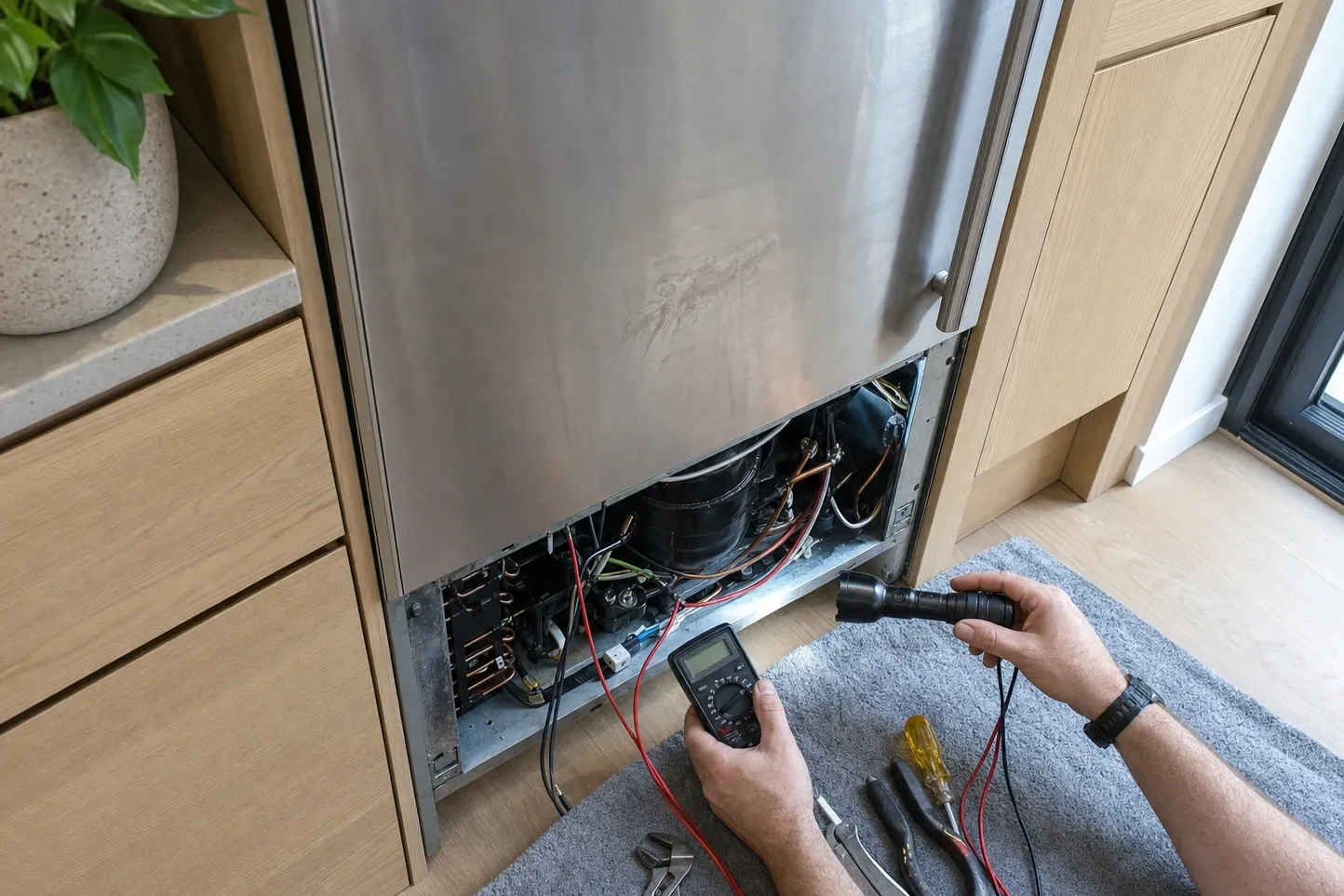
East side
Crestmoor
Low ranch houses on wide lots east of the city, where the kitchen has usually been rebuilt at least once and the refrigeration came with it.
-
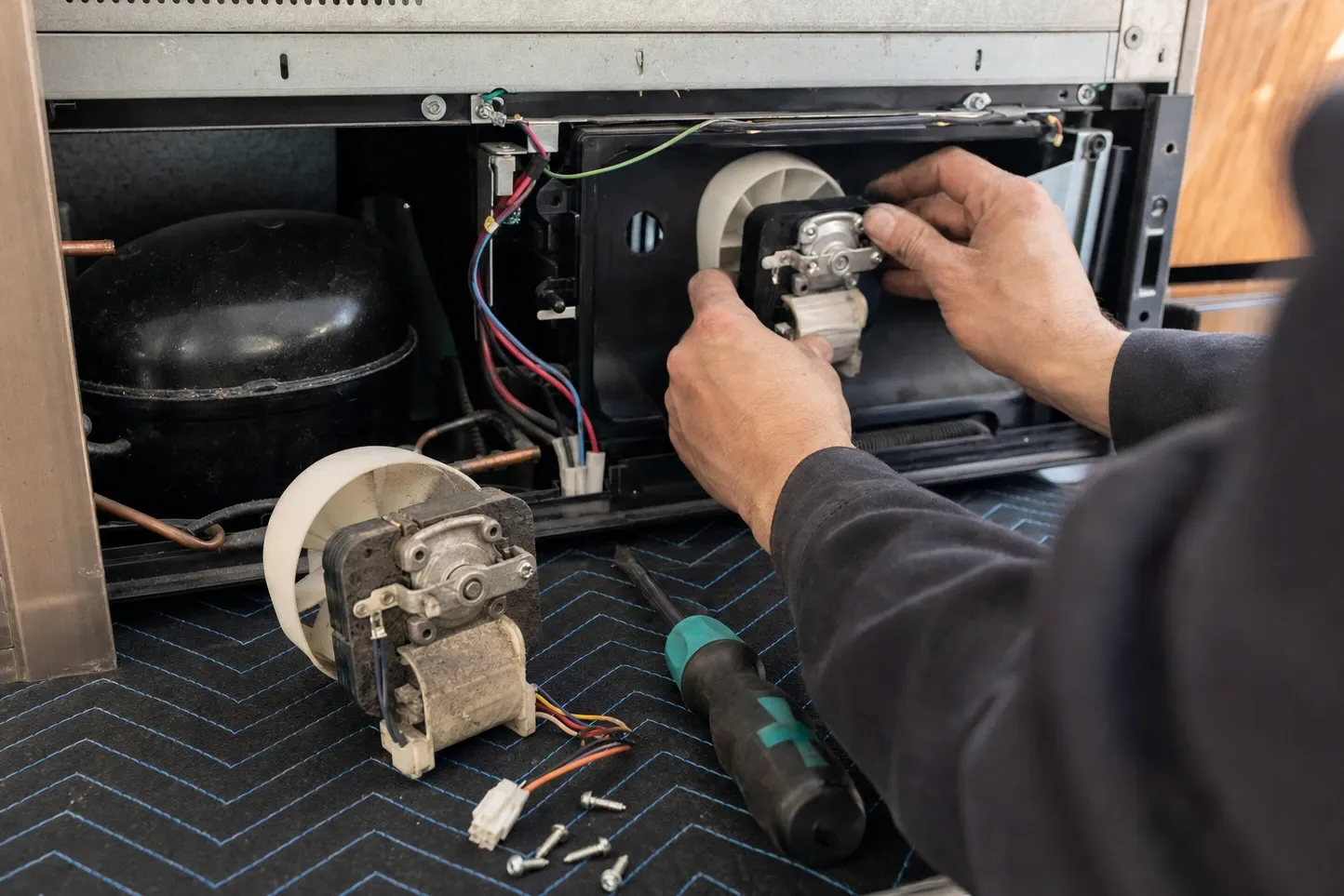
East side
Hale
One of Denver's East neighbourhoods, and one of the places where a built-in put in during the first kitchen remodel is still the one running.
Right now
Cabinet already warm? Four things that help
The line is answered 24/7, so a unit that fails at midnight can have a slot held before the crew starts at 8:00 am. Until then:
Call (720) 770-4189- 1 Leave the doors shut. A closed cabinet holds its load far longer than one opened every ten minutes.
- 2 Anything irreplaceable goes into a cooler with ice — not into the freezer side of the same machine.
- 3 Lift the grille and look at the condenser. Lint packed across it accounts for a great many warm-cabinet calls.
- 4 Do not pull the plug for a few hours to reset it. That erases the evidence and the fault returns in two days.