Keeping an Older Sub-Zero Running · part 2 of 4 · Freezer Repair
Inheriting a Sub-Zero with the house: a first-week checklist
Written by Curtis Mahoney Refrigeration technician — defrost and control faults · 16 years in the trade
Reads the defrost cycle before he reads the compressor: heater, terminator, then drain, in that order. A blocked drain and a dead heater present as the same sheet of ice, and only one of them is worth a part.
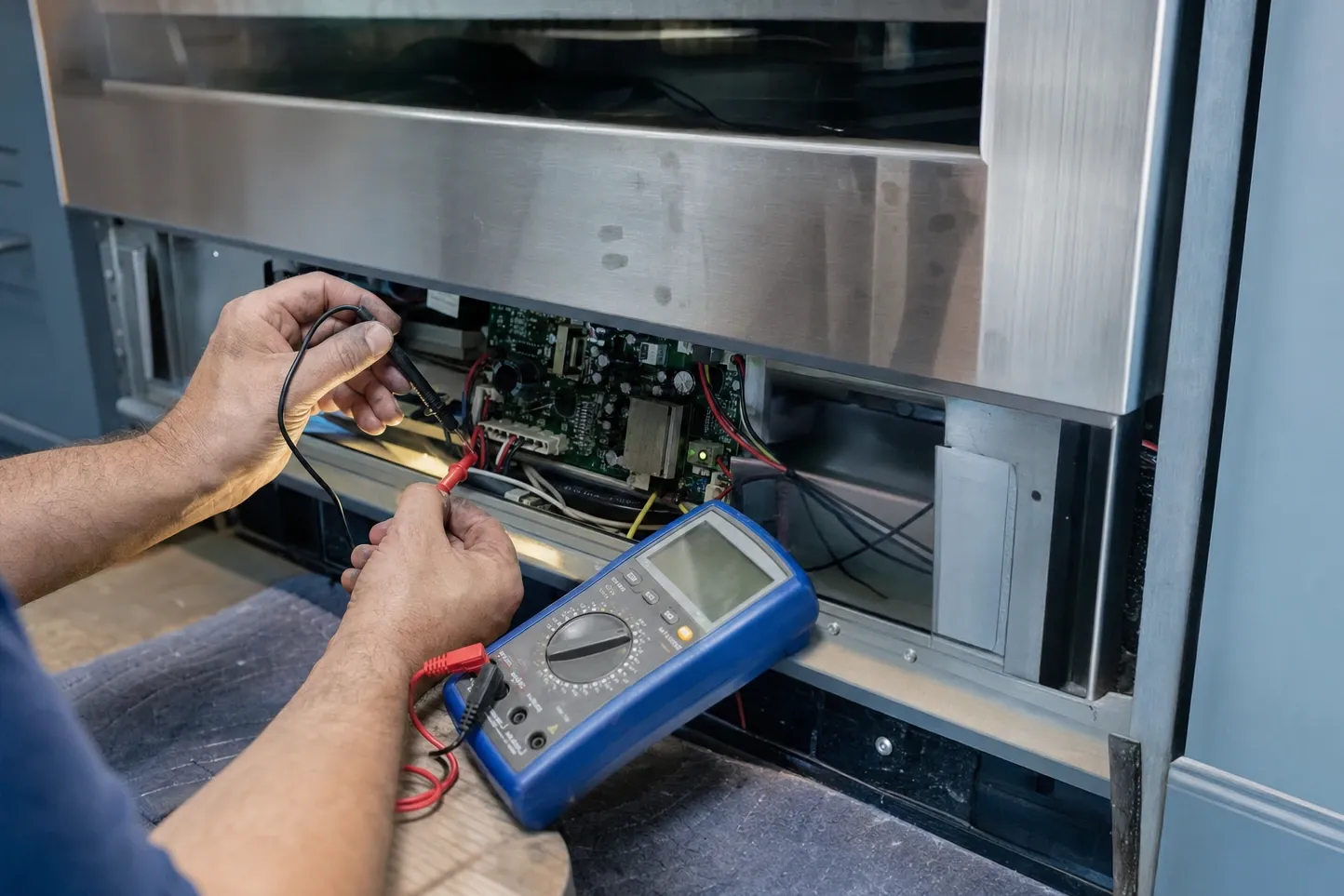
A built-in came with the house. Nobody left the manual, the service history, or the name of whoever last had the grille off.
Seven checks over the first week settle what you actually own. None of them needs a tool you do not have, and none of them opens anything sealed.
The week in one list
- Find the rating tag.
- Photograph it.
- Place the designation.
- Stand a thermometer in each compartment.
- Take the grille off and look.
- Walk both gaskets with a strip of paper.
- Listen to it once, with the kitchen quiet.
Work down the list in order. Everything from check three onward is read against what check one hands you.
1. The rating tag
Sub-Zero puts a tag on every cabinet carrying the model number, the serial number, the date it was manufactured, the total amps and, on its refrigeration, the refrigerant type and the size of the charge. That single label answers “what is it” and “how old is it” in one go.
Where it hides depends on the family, and the pattern is worth knowing before you start hunting:
- Full-size cabinets of the 500, 600, BI and Classic lines: inside a door, high up by the top hinge. Over-and-under models put it in the refrigerator door, side-by-sides in the freezer door, French-door models in the left-hand door.
- 700 Series and the tall or drawer Designer units: not in a door at all, but inside the cabinet to the left of the upper drawer.
- Designer columns: inside the middle drawer, by the drawer guide on the side away from the hinge.
- Professional cabinets, PRO4850 and 648PRO: inside, to the left of the upper freezer drawer.
2. The photograph
Photograph the tag square on, close enough to read every line, and keep it where you can find it. Every parts conversation you ever have about this cabinet starts with those two numbers.
Do it now rather than when something is wrong. A tag inside a freezer door is much harder to read with the compartment emptied onto the kitchen floor.
3. The designation
Letters carry the family, numbers carry the cabinet. In Sub-Zero’s own model-number key, CL is Classic, BI and BW are Legacy Classic — formerly Built In — while IT, IC, ID and IW are Legacy Designer, formerly Integrated, and DET, DEC and DEU are Designer. PRO and 648PRO are the Professional cabinet, UC the undercounters.
A plain number with no prefix — 532, 650, 700TR — puts you in one of the older lines, and that is the common case in a house that has changed hands once or twice.
The trailing letters describe the layout rather than the age: R is an all-refrigerator, F an all-freezer, S a side-by-side, U over-and-under, FD a French door, G a glass door.
4. Two thermometers, overnight
Buy two cheap dial or digital thermometers, stand one in the middle of each compartment, and read them in the morning before anybody opens a door. You are testing the cabinet, not the display.
For a yardstick: a 700 Series arrives preset at 0°F in the freezer and 38°F on the fresh-food side, and either can be moved a degree at a time. A cabinet sitting a long way off those numbers overnight has told you something the panel did not.
5. Behind the grille
The grille at the top or the base comes off by hand. On a 500 Series cabinet it lifts, pulls out at the bottom, and drops off its mounting bracket; later cabinets hide the condenser behind a kickplate at the floor instead.
What you are looking for is felt. Years of dust packs into the fins until the coil cannot shed heat into the room, and every other symptom in the cabinet follows from that.
How often it needs doing depends on the cabinet. Sub-Zero sets the interval at three to six months for a 500 Series and at six to twelve for the Classic, Built-In and PRO 48 cabinets. A soft brush and a vacuum hose do the work, with the unit switched off first — on a 590 that means the master power switch behind the top grille.
6. The gaskets
Built-in doors seal on a four-sided magnetic gasket, and gaskets fail by taking a set rather than by splitting. Shut a strip of paper in the door and pull: it should drag. Repeat every hand’s width along all four sides of both doors.
Two other signs count here. A door that needs pushing to catch, and — on an integrated cabinet, which chimes when a door or drawer has stood open past half a minute — an alarm that sounds when nobody is near the kitchen.
7. The quiet listen
Stand in the kitchen last thing at night and let it run. The 500 Series manual sets out what healthy sounds like: a faint hum while the compressors turn, a second or two of vibration as one starts or stops, and during a freezer defrost a sizzle at the coil with water running into the pan underneath.
Two compressors, not one, is normal on these cabinets. Sub-Zero’s dual refrigeration gives each compartment its own sealed system, which is why a built-in starts and stops twice as often as the appliance you grew up with, and why one side can be perfect while the other is not.
What the week tells you
Read the findings together rather than one at a time. A warm compartment with a furred condenser and a gasket that lets paper slide is one story; the same warm compartment behind a clean coil and tight doors is another, and the difference is worth knowing before anybody quotes you.
When a check does turn something up, the numbers off that tag are the first thing to say out loud. Sub-Zero Repair Service Denver takes them on (720) 770-4189, and the visit with a full diagnosis is $89, credited against the repair.
Follow-ups
- Can I work out the age without a serial number decoder?
- You do not need one. Sub-Zero prints the date of manufacture on the rating tag itself, beside the model and serial numbers, so the age is read rather than calculated. If the tag is unreadable under thirty years of kitchen film, wipe it with a damp cloth and photograph it with a flash before assuming the numbers are gone.
- The previous owner left no service records at all. Does that matter?
- Less than people expect. A parts desk works from the model and serial numbers, not from a history, and the condition of the condenser, the gaskets and the two compartment temperatures tells a technician most of what a folder of receipts would. Records are useful while the manufacturer still covers the machine, and a cabinet of this age is long past that.
- Nothing seems wrong with it. Is a visit worth booking anyway?
- Only if one of the seven checks turned something up: a warm compartment overnight, a gasket that lets paper slide, a condenser nobody has touched in years. Sub-Zero Repair Service Denver charges $89 for the visit and the full diagnosis on (720) 770-4189, and that $89 comes off the repair if you go ahead.
Step one of the week is the rating plate . The designation then tells you which series replaced which . A cabinet that cannot hold zero is freezer repair .