Keeping an Older Sub-Zero Running · part 3 of 4 · Refrigerator Repair
Keeping the old Sub-Zero through a kitchen remodel: clearances, power, panels
Written by Curtis Mahoney Refrigeration technician — defrost and control faults · 16 years in the trade
Reads the defrost cycle before he reads the compressor: heater, terminator, then drain, in that order. A blocked drain and a dead heater present as the same sheet of ice, and only one of them is worth a part.
A built-in that still holds temperature is worth keeping through a remodel. The cabinet usually outlives the kitchen around it.
What makes that go wrong is sequence. Four things have to be settled before anybody orders carcasses: the opening, the finished height, the air path, and the circuit.
The opening
Sub-Zero publishes an opening per model, not one figure for built-ins as a class, so the first job is to read the designation off the rating plate and look it up against its own family.
For a Classic cabinet in a standard installation the opening is 24 in deep and 83 3/4 in high against the usual 84 in overall unit height. The width follows the cabinet: 29 1/2 in for a 30-inch model, 35 1/2 in for a 36, 41 1/2 in for a 42 and 47 1/2 in for a 48. The guide also warns that 3 1/2 in finished returns will be visible and should be finished to match the cabinetry, which is a joinery decision, not a delivery-day one.
The integrated line works to its own set. A column opening is 27 in by 81 in; the tall cabinets take 27 in by 80 in, or 36 in by 80 in for the 36-inch models; the drawer units want 27 in by 34 1/2 in. Every integrated model is 24 in deep, and Sub-Zero notes that panel thickness has to be allowed for when the finished opening depth is planned.
Two cabinets side by side is a separate drawing again. Classic dual openings are 59 3/4 in for two 30-inch units, 65 3/4 in for a 30 beside a 36 and 71 3/4 in for two 36s, and a dual installation kit is required. On the integrated line the dual opening is simply the two widths added together, with a kit — or a filler strip of at least 2 in between the units if no kit is specified.
The grille and the finished height
The grille is not trim. On Classic cabinets it is supplied to suit an overall unit height of 84 in as standard, or 83 in or 88 in as alternatives, and the one you order has to match the height the kitchen is being built to.
That choice moves the opening. Specify the 83 in grille height and the opening height comes down by 7/8 in; specify 88 in and it goes up by 4 in. Decide the soffit before the grille is ordered, not after.
Airflow at the condenser
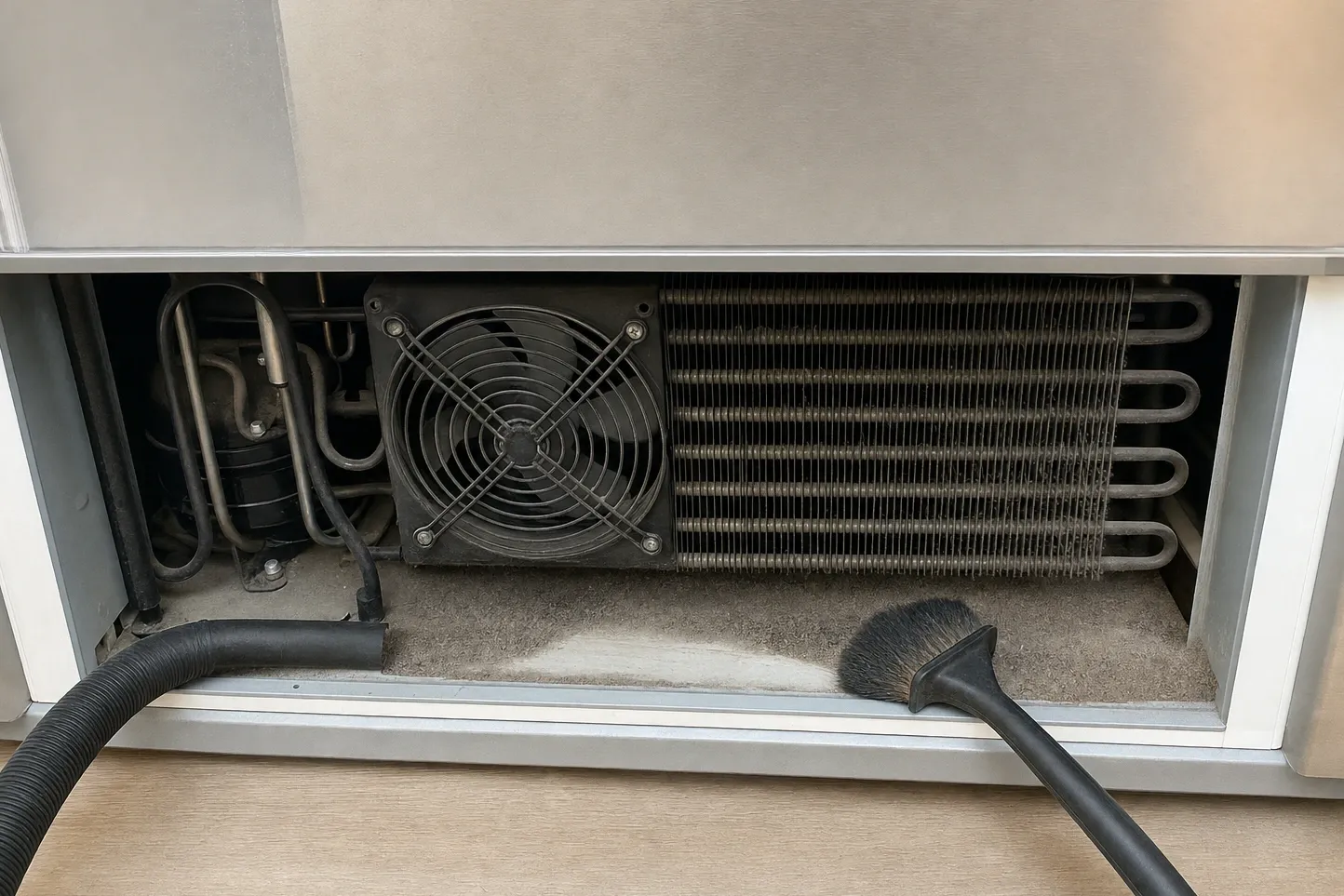
These cabinets vent through the front, which is exactly why they can be enclosed on all sides in a run of cabinetry. Everything they need is drawn through the grille or the kickplate, so that opening is a working part and not a panel to be tidied away.
Two habits kill it: a fixed plinth across the base, and base moulding that cannot be lifted. Sub-Zero’s integrated guide states plainly that base moulding must be removable, caps the toe-kick height, and lets the kickplate or grille be adjusted forward to meet it.
Access matters as much as air. Somebody has to pull that grille off and vacuum the coil every three to six months on a 500 Series cabinet, or every six to twelve on a Classic, Built-In or PRO 48.
The circuit
The electrical requirement is the same on both lines and it is short: 115 VAC at 60 Hz, 15 amps, a three-prong grounding-type receptacle, and a separate circuit servicing only this appliance. Sub-Zero adds that a ground fault circuit interrupter is not recommended, because it can interrupt operation, and that the installation has to satisfy the electrical codes that apply.
The outlet position is drawn in the guide rather than left to the fitter, and on integrated models Sub-Zero even specifies its orientation: the grounding prong sits to the right of the thinner blades. Hand that page to the electrician and let them site it.
If the cabinet takes water, the rough-in has rules of its own. The supply is 1/4 in outside-diameter copper, braided stainless steel or PEX, run to an accessible shut-off valve, with self-piercing valves ruled out and the line kept clear of the anti-tip bracket. The published pressure window is 35 to 120 psi on a Classic cabinet and 20 to 100 psi on an integrated one, with spare line left coiled for the final connection.
Panels and handles
A Classic cabinet can be finished four ways — framed, overlay, flush inset, or stainless — and each one has a minimum panel thickness. Framed panels start at 1/4 in; overlay and flush inset start at 5/8 in, as do all panels on the integrated line. An overlay panel is really an assembly: the custom panel, a thin spacer and a backer panel behind it.
Weight is the limit people miss. Sub-Zero caps a Classic door panel at 50 lb, or 75 lb on the 36-inch all-refrigerator and all-freezer models, and a grille panel at 13 lb. A cabinetmaker who chooses quarter-sawn oak for a full-height door can sail past that without ever weighing one.
Three more lines for the drawings. Flush inset panels thicker than 3/4 in may need a 90-degree door stop to clear the cabinets beside them; a glass door must never be covered with a solid panel; and every face of a custom panel gets finished, because you see the back of one whenever the door swings.
Taking it out and putting it back
Weight decides who handles it. On the integrated line Sub-Zero quotes a shipping weight of around 360 lb for a column or a 27-inch tall cabinet, 480 lb for the 36-inch tall models and 190 lb for a drawer unit, and a full-size built-in is in the same country.
That is a job for the trade fitting the kitchen, on equipment, over protected floor. The anti-tip bracket goes back the way it came out, and the water line is routed clear of it.
One clearance is easy to lose to a new island. Sub-Zero’s integrated guide notes that where a door can only open to 90 degrees, door shelves may have to come out before a storage drawer or a glass shelf will.
The three lines to hand your cabinetmaker
Give them the designation from the rating plate, the opening that family needs in all three dimensions, and the overall unit height the grille will be ordered to suit. Everything else on the drawing follows from those.
If the plate is unreadable or the model is not one anybody recognises, read what you can see down the phone. Sub-Zero Repair Service Denver will place the cabinet and confirm what its opening wants on (720) 770-4189, and a full diagnosis on site is $89, credited to the repair if one is needed.
Follow-ups
- Will a cabinet from the 1990s fit an opening built to today's drawings?
- Only the drawings for its own family answer that. Sub-Zero publishes an opening width, height and depth per model rather than one figure for built-ins generally, so the designation off the rating plate has to go to whoever sets out the run. Give it to them in writing before the carcasses are ordered.
- Can the electrician put the refrigerator on the same circuit as the ovens?
- No. Sub-Zero asks for a separate circuit servicing only this appliance, at 115 volts and 15 amps, into a three-prong grounding-type receptacle, and its guides say a ground fault circuit interrupter is not recommended because it can interrupt operation. Give an electrician that requirement and let them square it with the local code.
- Who should move the cabinet while the floor goes down?
- The trade fitting the kitchen, with equipment. An integrated column ships at around 360 lb and the 36-inch tall models at around 480 lb, and the anti-tip bracket has to go back exactly as it came out. Nobody should walk one of these across a new floor on its own feet.
Integrated units — the 700 Series — are the ones with published opening sizes. Full-size BI and Classic cabinets take a grille sized to the finished height. Give your cabinetmaker the designation from the series reference .