Keeping an Older Sub-Zero Running · part 1 of 4 · Refrigerator Repair
What wears out first on a 25-year-old Sub-Zero, in order
Written by Curtis Mahoney Refrigeration technician — defrost and control faults · 16 years in the trade
Reads the defrost cycle before he reads the compressor: heater, terminator, then drain, in that order. A blocked drain and a dead heater present as the same sheet of ice, and only one of them is worth a part.
Parts on an old built-in do not fail at random. They fail in a rough sequence, set by which ones do the most work and which ones live in the warmest, dirtiest part of the cabinet.
Knowing the sequence is worth more than knowing any single fault. It tells you which noise to take seriously, which one to ignore, and which repair is the one that decides the cabinet’s future.
The sequence, in one list
- The condenser and the fan behind the grille.
- Door and drawer seals.
- The defrost circuit.
- The ice maker and its water path.
- Lamps, switches and interior fittings.
- The control board, on the generations that have one.
- The sealed system.
Items one to five are ordinary repairs on any cabinet worth keeping. Six and seven are the two that need a decision.
1. Condenser and grille fan
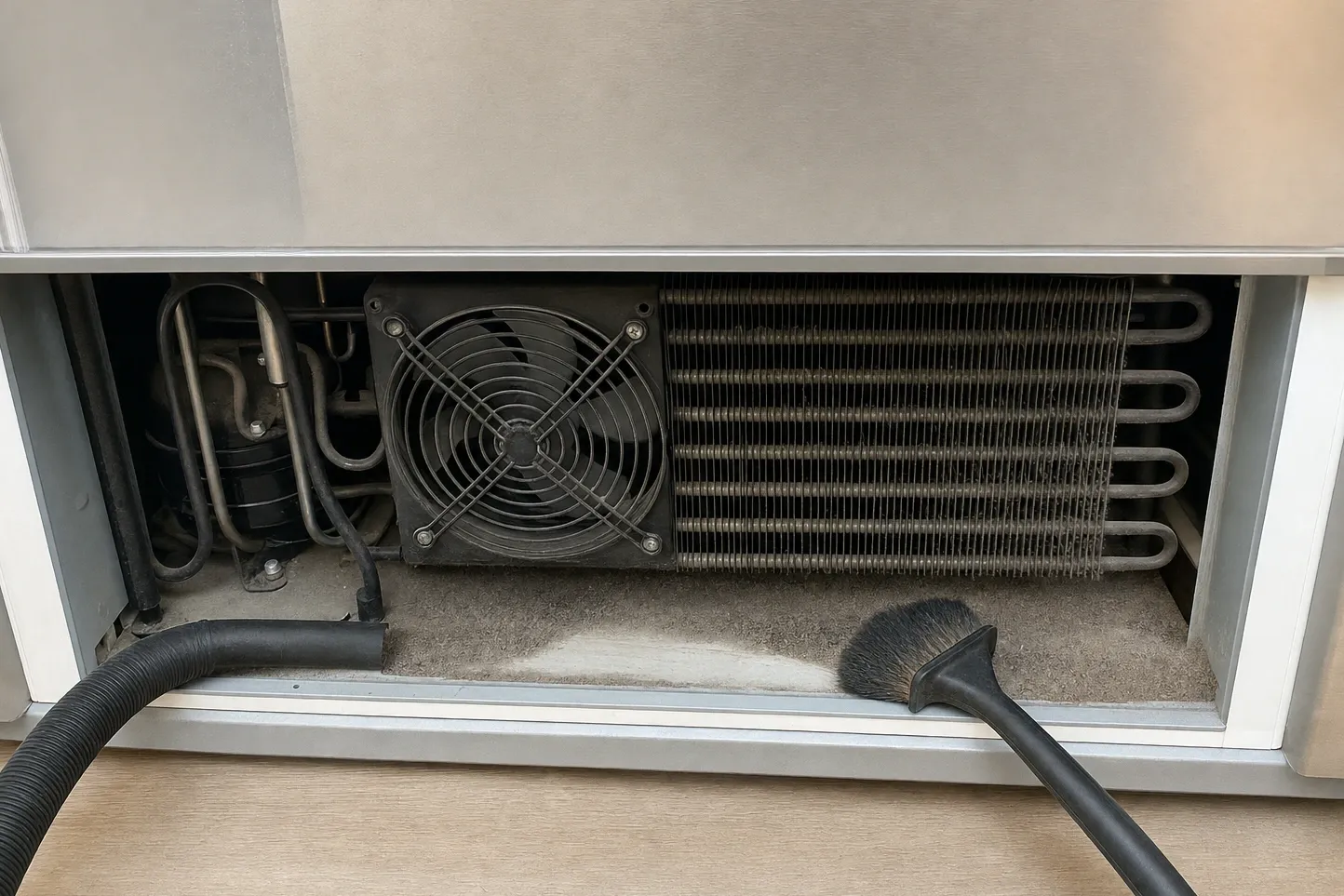
This is first because it is the only one that is partly your job. Dust and lint pack the fins behind the grille, the coil stops rejecting heat into the room, and the cabinet starts losing ground on a warm afternoon.
Sub-Zero sets the interval itself, and it is not the same across the range. The 500 Series manual asks for every three to six months under normal use. For the later Classic and Built-In cabinets, Sub-Zero says every six to twelve months.
The method is the same either way: power off, grille off, a soft-bristle brush and a vacuum hose along the fins. Gloves, because the fins are sharp.
The fan is the part that actually fails. On a 500 Series cabinet a single fan behind the grille cools the machine area and runs with either compressor, so when its bearing goes both circuits lose their heat rejection at once. A condenser fan is a cheap part in a bad place, and it is the commonest motor we replace.
2. Door and drawer seals
A built-in door seal is a four-sided magnetic gasket, and it dies slowly. It does not split; it takes a set, holds the shape it was last compressed into, and stops touching the cabinet along one edge.
The symptom is frost that comes back in the same corner after every clear-out, and a door that needs a shove to catch. On a cabinet with a door-ajar alarm, another sign is the chime going off when nobody has left the door open — a Sub-Zero that has the feature sounds it when a door or drawer has been ajar for more than thirty seconds.
Seals are the part we fit most on older cabinets, and they are still ordered against the model and serial rather than the series, because profiles changed between cabinets in the same family.
3. The defrost circuit
Every built-in makes frost. What matters is whether it is cleared on schedule. When the circuit stops clearing it, ice sheets over the evaporator, air stops moving, and the display goes on reporting a believable number while the far end of the cabinet climbs.
Some noise here is normal and documented. During a freezer defrost you may hear crackling or sizzling as the element clears the coil and the meltwater runs into the defrost pan. What is not normal is water arriving on the floor under the grille instead of in that pan.
The circuit is three parts — a heater, a limit and a sensor — and all three are ordinary stock repairs. This is the last item on the list that is straightforward on every generation.
4. The ice maker and its water path
Ice is the most legible part of the cabinet, because it hands you a physical sample of its own condition several times a day. Hollow, cloudy or fused cubes, or a mould that stays full, are all read from the bin without opening anything.
In Denver the first thing to look for is scale. Hard city water furs the fill cup and the mould, slows the harvest, and fuses cubes into a lump in the bin. That is descaling and a filter, not a module.
Module availability is where older cabinets start to differ. On some generations it is an ordinary order; on others the number has been superseded or dropped, and that is settled against your plate before anyone promises a repair.
5. Lamps, switches and interior fittings
Small, cheap, and the category most likely to defeat you. A compartment that stays dark is as often the door switch as the bulb. Shelves crack, bin lugs break, dispenser trim goes brittle.
None of it stops the cabinet working, and all of it is the hardest to buy. Interior fittings are superseded more often than mechanical parts, because the mechanical parts stayed the same across revisions and the plastics did not.
6. The control board, where there is one
Not every generation has one to fail. The 500 Series manual documents temperature controls, an ice maker switch with an indicator lamp, automatic defrost and a master power switch — and no electronic control system at all.
From the 600 Series on there is a board. Sub-Zero describes the Built-In electronic control system as monitoring and displaying temperatures within one degree of the preset, and the later integrated cabinets add a service indicator that lights when the control system has found a temperature or ice maker problem, or when the condenser needs cleaning.
A board is a real repair on a cabinet of this age, and it is the first item on this list where the answer might be that the part is no longer supplied. It is also the first place where a diagnosis is worth paying for rather than guessing at, because a board is frequently blamed for a sensor.
7. The sealed system
Last, least often, and most expensive. Compressor, condenser, evaporator, drier and the tubing between them: a closed circuit that is not meant to be opened in the life of the cabinet and usually is not.
Two ordinary noises are documented and are not this. A slight hum while the compressors run, and a few seconds of vibration as one starts or stops, are normal on these cabinets. A new note that arrives and does not settle is worth a call.
If the plate names R-12, that changes what a sealed-system repair involves, though it changes nothing about items one to six. Production and import of CFCs in the United States ended on 1 January 1996, and the plate is where you find out which side of that your cabinet is on.
What to do with the sequence
Work down it, not across it. A cabinet that is warm has usually failed at item one or three, and the money spent proving that is the $89 service call, credited against the repair if you go ahead.
The decision point is between five and six. Everything above it is maintenance on a machine that was built to be maintained. Below it, the question stops being what is broken and becomes what is still supplied — which is a question about your model and serial, and Sub-Zero Repair Service Denver will read the plate with you on (720) 770-4189.
Follow-ups
- Is there an age at which a Sub-Zero stops being worth repairing?
- No age, but there is a threshold, and it is about parts rather than years. While the failures are seals, fans, defrost components and sensors, a repair is ordinary money against a cabinet that cost a great deal. The arithmetic changes when the failure is a board nobody catalogues any more, or the sealed system itself.
- Does a service indicator mean something is broken?
- Not necessarily. On a Sub-Zero that has one, the service indicator lights or flashes when the control system has found a temperature or ice maker problem, or when the condenser needs cleaning. Cleaning the condenser is the first thing to rule out, because it is the one cause on that list you can deal with yourself.
- How do I know which series I have before I call?
- Read the rating plate. On a 500, 600, BI or Classic cabinet it is near the top door hinge on the inside of the door; on a 700 Series or integrated unit, left of the upper drawer inside the cabinet. Give Sub-Zero Repair Service Denver the model and serial on (720) 770-4189 and the parts list follows.
Most cabinets of that age in Denver are 600 Series . Each item below is worth checking against what is still catalogued . The whole list is ordinary refrigerator repair work.